What Is Keyword Density?
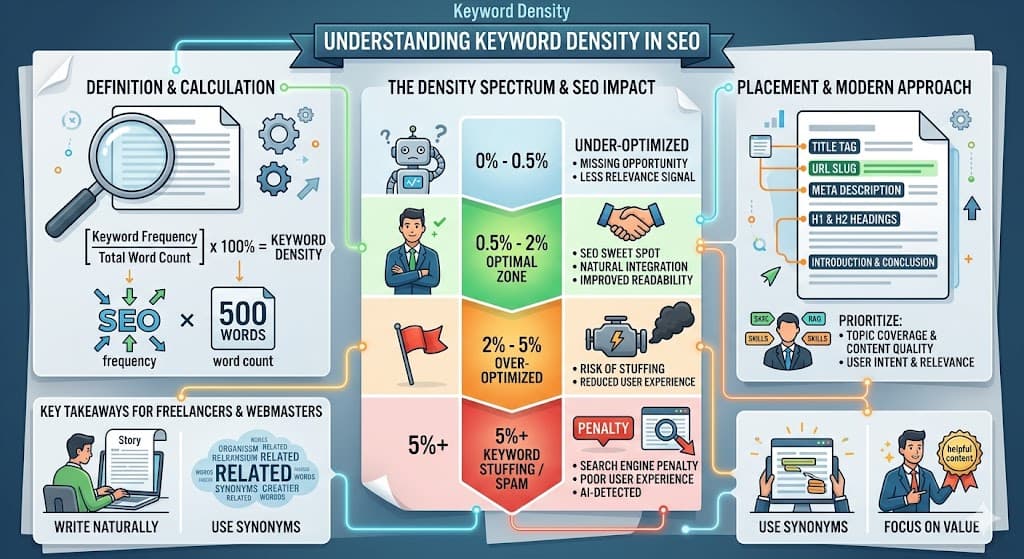
Keyword density is the percentage of times a target keyword appears in a piece of text relative to the total word count.
Formula:
Keyword Density (%) = (Number of keyword occurrences ÷ Total word count) × 100
Example: If your article is 1,000 words long and your keyword "PDF compressor" appears 15 times, the density is 1.5%.
What Is the Ideal Keyword Density?
The SEO industry consensus in 2026 is 1–2% for a primary keyword. Here's what that means in practice:
| Article length | 1% density | 2% density |
|---|---|---|
| 500 words | 5 occurrences | 10 occurrences |
| 1,000 words | 10 occurrences | 20 occurrences |
| 1,500 words | 15 occurrences | 30 occurrences |
| 2,000 words | 20 occurrences | 40 occurrences |
| 3,000 words | 30 occurrences | 60 occurrences |
These are guidelines, not hard rules. Google has not used keyword density as a direct ranking signal since the Panda update (2011). However, density remains a useful proxy for topical relevance — if your primary keyword barely appears in a 2,000-word article, something is probably wrong with your content structure.
Why 1–2%? The Origins of the Range
The 1–2% range emerged from early SEO experiments in the 2000s and has persisted because it roughly corresponds to natural language usage. When a competent human writer covers a topic in depth:
- The primary topic keyword tends to appear in headings, the opening paragraph, and naturally throughout body text
- This organic frequency typically lands between 1–2% without any intentional stuffing
- Going above 2% usually requires forced, unnatural repetition that degrades readability
Think of it as a sanity check: if you're below 0.5%, your content may be too vague; if you're above 3%, you're likely over-optimising.
How to Calculate Keyword Density Accurately
Manual method (for short texts)
- Copy your text into a word processor
- Use Find & Replace (Ctrl+H) to count the keyword: replace "keyword" with "keyword" and note the number of replacements
- Divide by total word count × 100
This gets tedious for anything over 500 words.
Using UtilVox Keyword Density Checker (recommended)
UtilVox Keyword Density Checker analyses any text or URL in seconds:
- Paste text directly into the text box, or enter a URL to analyse a live page
- The tool counts every word and phrase (1-gram, 2-gram, 3-gram)
- Results are sorted by frequency — your primary keyword should appear in the top 5
- Check the % column to see density for each term
For SEO work, focus on the 2-word phrase (bigram) column — this is where your target keyword phrase usually appears.
How to Achieve 1–2% Without Keyword Stuffing
The goal is natural density, not mechanical repetition. Here are the techniques:
1. Place the keyword in structural positions
These positions carry more semantic weight and count toward density:
- Title / H1 — once
- First 100 words — once, naturally
- One H2 subheading — once
- Conclusion paragraph — once
- Meta description — once (doesn't count toward page density, but reinforces relevance)
For a 1,000-word article, these structural placements alone give you 4–5 occurrences (0.4–0.5%). The remaining 5–15 occurrences come from natural body text.
2. Use semantic variants
Google understands synonyms and related terms. These do not dilute your primary keyword density — they complement it:
| Primary keyword | Acceptable variants |
|---|---|
| PDF compressor | compress PDF, reduce PDF size, shrink PDF, PDF file size reducer |
| keyword density | keyword frequency, keyword ratio, term density |
| image resizer | resize image, image dimensions, resize photo |
Write naturally using variants. The Keyword Density Checker will show these as separate bigrams — that's fine.
3. Check density after writing, not during
Keyword density is an editing metric, not a writing metric. Write your full draft naturally, then run it through UtilVox Keyword Density Checker. If you're below 1%, add a subheading that includes the keyword or expand a section where you naturally use the phrase. If you're above 2%, replace some direct keyword mentions with pronouns or synonyms.
Keyword Density for CSS/PMS Précis in Pakistan
Pakistani competitive exam candidates — particularly those preparing for CSS and PMS précis writing — use keyword density analysis differently:
In a précis, the examiner expects you to capture the key ideas of the original passage. Running the original passage through the Keyword Density Checker tells you which terms the author considered most important. These are the terms you must preserve in your reduced text.
Practical workflow:
- Paste the original passage into Keyword Density Checker
- Note the top 5–8 most frequent terms
- Write your précis ensuring each of those terms appears at least once
- Verify your précis is exactly one-third of the original word count using Word Counter
This approach significantly improves précis marks because the key terms signal you've understood the passage's central arguments.
Common Keyword Density Mistakes
Mistake 1: Treating density as a target rather than a guardrail Write for humans first. The density check is to catch extremes — either you've barely mentioned your topic (too low) or you've become repetitive (too high).
Mistake 2: Only checking the primary keyword Also check that your semantic variants and LSI (Latent Semantic Indexing) terms appear. A page about "PDF compression" should also mention "file size," "PDF quality," "lossy," and "lossless" — these terms signal content depth to Google.
Mistake 3: Counting keyword in navigation and headers If you're analysing a live URL, the tool picks up navigation text, footer links, and sidebar content. For accurate results, paste only the body text.
Mistake 4: Chasing density at the expense of readability Google's Helpful Content system (2023 onwards) uses human-quality signals. An article that reads awkwardly because of repeated keyword usage will underperform a well-written article with slightly lower density.
How Google Actually Uses Keyword Signals in 2026
Google does not use keyword density as a direct ranking factor. What it does use:
- TF-IDF (Term Frequency–Inverse Document Frequency) — how often a term appears compared to other pages in the index on the same topic
- Entity recognition — whether the named entities in your content match the topic
- Topical authority — whether your site has multiple pages covering related sub-topics
- User signals — dwell time, return-to-SERP rate
Keyword density analysis remains useful as a self-check tool: it tells you whether your content is coherent and focused on your intended topic.
Quick Reference
| Density | Interpretation | Action |
|---|---|---|
| < 0.5% | Under-optimised | Add keyword to more headings and body text |
| 0.5–1% | Acceptable for long-form | Fine if content is comprehensive |
| 1–2% | Ideal range | No action needed |
| 2–3% | Slightly high | Replace some instances with synonyms |
| > 3% | Over-optimised | Edit aggressively — risk of spam signals |
Use UtilVox Keyword Density Checker to verify your content before publishing. It's free, requires no account, and analyses pages by URL — so you can check competitors' content too.